
Home » Archives for Swami Nirmalananda Giri (Abbot George Burke) » Page 43

Jesus Expounds the Law of Karma in the Aquarian Gospel

Jesus Aquarian Gospel law of karma quote“The Lord with Peter, James and John were in Jerusalem; it was the Sabbath day. And as they walked along the way they saw a man who could not see; he had been blind from birth. And Peter said, Lord, if disease and imperfections all are caused by sin, who was the sinner in this case? the parents or the man himself?

And Jesus said, Afflictions all are partial payments on a debt, or debts, that have been made. There is a law of recompense that never fails, and it is summarized in that true rule of life: Whatsoever man shall do to any other man some other man will do to him. In this we find the meaning of the Jewish law, expressed concisely in the words, Tooth for a tooth; life for a life. He who shall injure any one in thought, or word, or deed, is judged a debtor to the law, and some one else shall, likewise, injure him in thought, or word or deed. And he who sheds the blood of any man will come upon the time when his blood shall be shed by man.

Affliction is a prison cell in which a man must stay until he pays his debts unless a master sets him free that he may have a better chance to pay his debts. Affliction is a certain sign that one has debts to pay. Behold this man! Once in another life he was a cruel man, and in a cruel way destroyed the eyes of one, a fellow man. The parents of this man once turned their faces on a blind and helpless man, and drove him from their door.
(Aquarian Gospel 138:1-13)

  • Afflictions all are partial payments on a debt, or debts, that have been made.

Some troubles are full payment and some are partial. But when it is over, the karmic debt has been reduced. That is the important thing.
“There is a law of recompense that never fails, and it is summarized in that true rule of life: Whatsoever man shall do to any other man some other man will do to him.”

  • There is a law of recompense that never fails, and it is summarized in that true rule of life: Whatsoever man shall do to any other man some other man will do to him.

Exactly what is done shall be done to us: the very same thing. If I steal, I will be stolen from; I will not just lose something of equal value to what I stole. Another human being will take it from me. This is very important. It is exact, like an echo: only what you say will come back to you, not something merely similar. Sometimes more than one karma will be be neutralized by a single thing that will reflect their general character. But, as I say, it is mostly an exact reaction.

Continue reading

5 Questions About God and Spiritual Practice

1. What is the nature of God: personal, impersonal, both equally, or is one of the two primary?

5 questions about spiritual practiceGod is only personal or impersonal in relation to a consciousness immersed in the duality of samsara. God is beyond the two, just as God is beyond samsara. So those in samsara will consider God either personal or impersonal, and being samsarins will no doubt wrangle with or disdain one another for holding a wrong view. Those who have gone beyond duality will be beyond personal/impersonal, and will keep silence–just as does Brahman.

2. What is the nature of spiritual practice/sadhana/yoga?

The only purpose of yoga sadhana is to realize the Self, both the individual and cosmic, the jivatman and the Paramatman. Therefore it must be exclusively adhyatmic in nature. A Brief Sanskrit Glossary defines adhyatmic: “pertaining to the Self (Atma), individual and Supreme.” A practice centered on an external “god” such as Shiva, Durga, Ganesha, etc., which is really only a symbol or portrayal of one or more aspects of God, or on an avatar such as Rama and Krishna, is by its and their nature partial and therefore limited and cannot lead to Self-realization and liberation in the Infinite. Gods and avatars only exist for us in samsara. Parabrahman, the Supreme, is beyond samsara and cannot be revealed through concentration or worship on either gods or avatars. To realize God we must get beyond all that which God is beyond.

3. Is meditation on OM and pranayama sufficient?

Since sadhana must be adhyatmic, the meditation and japa of Om, which involves observation of the breath (which is the highest pranayama), is both sufficient and essential. Patanjali says very clearly: “Its japa and meditation is the way” (Yoga Sutras 1:28).

Continue reading

Real Spiritual Teachers vs. Super-Gurus

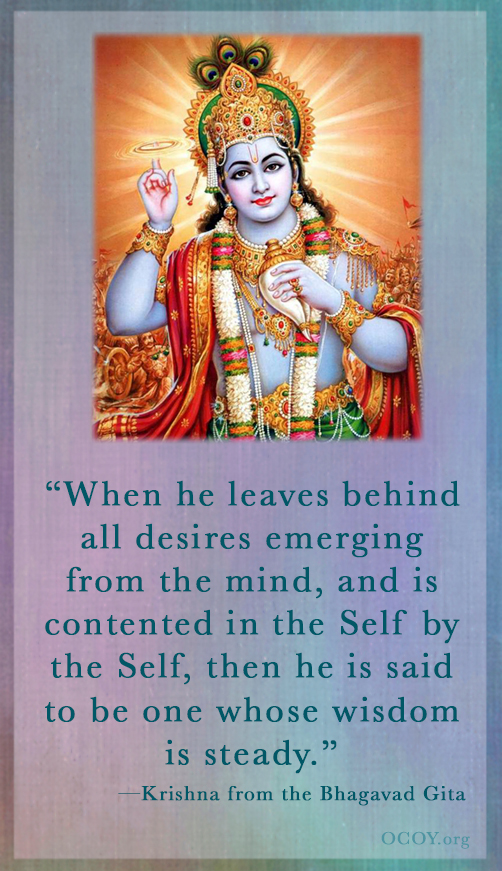
krishna quote-qualities of a real super-guruAn excerpt from The Bhagavad Gita for Awakening

“The Holy Lord said: When he leaves behind all desires emerging from the mind, and is contented in the Self by the Self, then he is said to be one whose wisdom is steady” (Bhagavad Gita 2:55).

Nothing could be easier to understand: an enlightened person wants nothing, finding total fulfillment in the Self–both individual and Universal.

Therefore when we see people with even “spiritual goals” such as “serving God in others” or exhibiting a veritable passion about a “world mission” or “saving” or “enlightening” others, we can know they are not illumined, and therefore incapable of doing any of those things in a real manner, however fine the exterior machinery might appear.

Qualities of a true spiritual teacher

A true spiritual teacher has no expectation of others whatsoever, much less foisting demands on them. Knowing that all growth comes from within, never from an outer factor–including him–the worthy teacher knows that it is his duty to teach, and that is the absolute end of the matter. From then on it is up to the student to either follow the teaching or not.

If he asks for help or advice from the teacher, it is the teacher’s duty to give the requested assistance and then leave the matter alone. (Swami Sri Yukteswar was a perfect example of this, as was Paramhansa Yogananda. They loved and cared deeply, but they also respected the freedom of those they taught.)

In spiritual life as well as material life there is a division of labor that should be adhered to. Under the guise of “love” or “devotion” there should be no violation of spiritual law. And no authentic teacher will ever break any law.

In contrast

It is virtually impossible to find any popular “guru” that does not live like “the jewel in the lotus”–both materially and socially. Although there is a pretense that their disciples are insistent upon it, it is really the guru that demands continual adulation and material accouterments that would have been considered extreme even for a Di Medici monarch.

Continue reading