
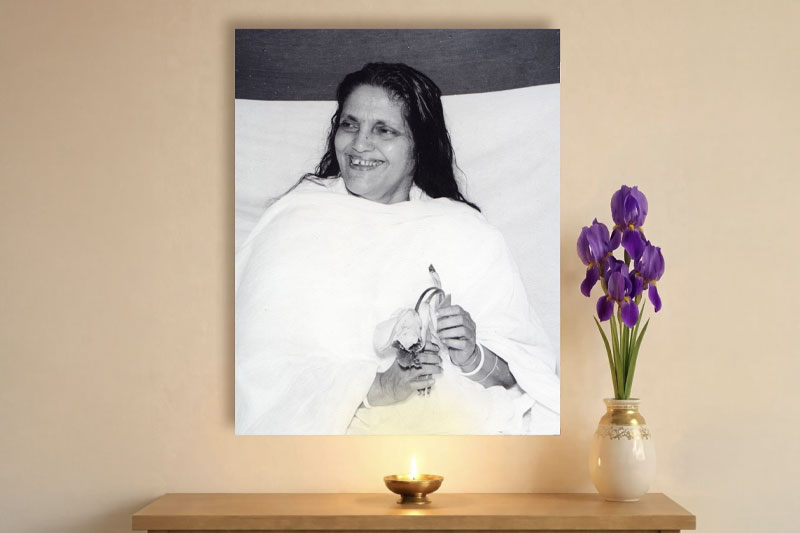
Introduction
This article presents selected reflections on the teachings of Sri Anandamayi Ma (1896–1982), one of the most revered spiritual figures of modern India.
The passages discussed here come from Words of Anandamayi Ma, a collection of her responses to questions asked by devotees during gatherings and spiritual meetings. These conversations were recorded and translated by Brahmacharini Atmanananda, one of Ma’s disciples.
The present article also introduces a forthcoming book by Swami Nirmalananda, The Eternal Wisdom of Anandamayi Ma, which offers commentary on these teachings and explores their deeper philosophical implications. Swamiji was under Anandamayi Ma’s guidance from 1963 until her leaving this world in 1982.
The selections below illustrate a central theme of Ma’s teaching: that ultimate truth cannot be confined to rigid concepts or final conclusions. Instead, spiritual understanding unfolds through direct experience and the expansion of consciousness beyond mere thoughts and ideas.
Note: The comments in italics are those of the original compiler. The words in bold type are the words of Ma herself.
The Nature of Ma’s Teachings
From Sri Ma one can but rarely get a definite decision on any problem. That is why I wondered of what use it was to write down Her utterances? I asked Sri Ma about it.
Ma was beyond definition and prediction. She stated that She did not have a mind–or therefore a will. Rather, everything She said or did was a “kheyala,” a spontaneous movement resulting in action that was not an act of thought, will or desire, or even definition. It simply occurred. A kheyala might be termed a divine movement. Mother never wanted or desired anything. Yet She told people what to do on occasion or declared what She was going to do. It was a revealing of divine will, not a personal desire. It was simply Truth and Reality in external expression.
Ma often said: “This body is a drum. According to how you beat it determines what you get in response.” Therefore the determining factor was the inquirer–not Ma. It was also unwise to ever say: “Ma always does,” or “Ma always says.” Certainly there were things that She usually said or did. But they were not absolutes. Therefore the devotee would always be ready for the unanticipated in word or deed.
Several times over the years, when I mentioned something Ma had said to me, or had told me to do, Atmananda, the translator-compiler of this book, would vehemently declare that Ma never said such or did things–that She always said or did the opposite. I would simply tell her to go ask the translator who relayed Ma’s words to me. She always found Ma had said or done those things. So she was wise in consulting Ma about writing down what eventually became Words of Sri Anandamayi Ma.
A State Beyond Mental Solutions
At least you have understood that there is a state, “where” problems are no longer settled in any particular way.
The word “where” implies that states of mind are not just conditions, but actual “places” that are both within and beyond spatial existence simultaneously. This is not fully graspable to the ordinary person, but learning it should prepare us for eventually experiencing it to some degree. It also gives us some understanding that Ma was always living in another dimension than we were. We were living in–and as–just a part, a fragment of reality, but Ma both lived in and was Herself the totality of Reality.
Human beings are creatures of habit and like consistency and predictability. But when we are endeavoring through yoga sadhana to expand our consciousness into the level of Unconditioned Consciousness that is the Divine Self, the Atman which is inseparable from the Paramatman, we have to realize that we are not going to remain in our previous and present state of consciousness. We even now must be prepared to think, will and act in that dawning expansion of both our inner and outer lives.
The ultimate answers lie in the area of consciousness where inner and outer do not exist: only unity. Since this is outside of ordinary awareness, predictability is only possible after thorough experience of that otherness. Therefore the wise sadhaka does not expect any thing, but is prepared for virtually everything.
Ma did not just live and move in a transcendent state of consciousness, She was the embodiment of that consciousness.
Early on in my first pilgrimage to India and Ma I met a great yogi-adept (yoga-siddha) named Sri Dattabal. He told me in our very first conversation that I should realize that I was not seeing the real Ma. Rather, I was seeing a kind of projection of Ma’s will which I could experience, relate to and communicate with. “If we saw Ma’s true being, we would instantly dissolve, because we are unreal and She is The Real. Her body is like a thin skin or veil which protects us and enable us to communicate with Her.” I readily understood and believed him because of what I had experienced when I first met Ma and She touched me–as I relate in my autobiography An Eagle’s Flight.
Reality Beyond Conceptual Thought
In the course of your life you have after careful consideration come to a decision on many questions, have you not? But now you will have to realize that no solution is ever conclusive; in other words, you will have to go beyond the level where there is certainty and uncertainty.
We are existing and actively living in the present moment and in eternity simultaneously, which is possible since there is really at all times only The One of which we are an inseparable “part” and which IS Ma even now. To our conditioned minds this seems contradictory, but that is the nature of relative existence. Ma was a demonstration that experience of this contradiction was possible. Ma was the unity that yet embraces duality–our relative experience–because it includes it as a reality, not a mere appearance. Since everything is a part of infinite Life it is both absolutely unmoving and in fluctuation simultaneously and yet, according to Ma, it is neither in the highest sense. Even illusion in one aspect is real: it is existing in our mind as an image or concept. This is why we speak of relative and absolute reality.
To sum up what Ma is saying: We must come to understand that words and concepts are certainly real and relate to lesser (lower) reality, but they cannot embrace the whole, the totality of anything due to our innate limitation of consciousness–both depth and breadth. So we can speak the truth about something, but that truth is of necessity always partial, not all-embracing/all-encompassing.
We must come to understand that our intellectual understanding/comprehension cannot encompass the entire reality of anything, but we certainly can comprehend or intellectually encompass it partially. Just as language is irrevocably limited, so is our intellectual comprehension. And when we add the realization that we can partially or totally misunderstand something, then we are ready to “make some sense of things.” We can understand while realizing that we cannot understand totally or flawlessly. So we work with what we have. We use words in definition and explanation, but realize that both uses are inherently limited and not absolutes at any time.
It is true that we can acknowledge that at all times Ma was incomprehensible, inexpressible and indefinable. But to some degree She was also comprehensible, expressible and definable. That is why the Eastern Orthodox Christians speak of apophatic theology: we may not be able to say precisely what God is, but we can certainly say what God is not. But of course, since we can say what God is not, we are at the same time saying what he is in a backhanded manner. In other words: Words cannot suffice.
And this what Ma is saying: We will have to realize that no solution is ever conclusive. We will have to go beyond the level where there is certainty and uncertainty. In other words, we must go beyond duality even in the intellectual realm.
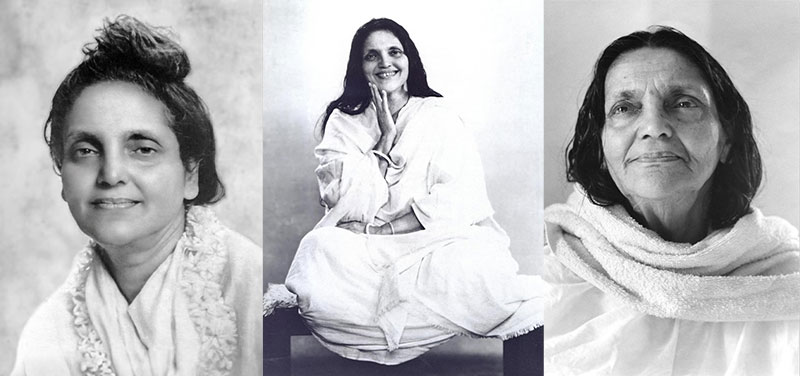
We are adding a collection of scanned and restored photos of Anandamayi Ma at our Etsy Store, SacredVisionsHQ, available as posters, framed art and foam mounted art, for the sake of devotees and to help support our outreach. Explore over 40 sacred images for your home, altar, and for gifts.
Explore more:
Frequently Asked Questions
Who was Sri Anandamayi Ma?
Sri Anandamayi Ma (1896–1982) was an Indian spiritual teacher widely regarded as a living embodiment of divine consciousness. Without formal training or institutional role, she attracted seekers from across India and around the world who recognized in her an extraordinary spiritual presence.
Her teachings were typically given in response to questions during gatherings (satsangs) with devotees. Rather than presenting a systematic philosophy, Ma often spoke spontaneously, emphasizing direct spiritual realization over conceptual understanding.
What is Words of Anandamayi Ma?
Words of Anandamayi Ma is a collection of Ma’s spoken responses to questions asked by devotees during gatherings and spiritual conversations. The material was recorded and translated by Brahmacharini Atmanananda, one of her close disciples.
The book preserves many informal conversations in which Ma answered questions about spiritual practice, consciousness, and the nature of reality.
What is this article about?
This article presents reflections on selected passages from Words of Anandamayi Ma. It highlights Ma’s teaching that ultimate truth cannot be confined to rigid concepts or final conclusions, but must be approached through direct spiritual experience.
What does Ma mean by going beyond certainty and uncertainty?
Ma points to a level of consciousness beyond ordinary mental categories. At that level, truth is not grasped merely by argument, fixed conclusions, or conceptual opposites, but by direct realization.
Why does the article say that no solution is ever conclusive?
The point is not that truth does not exist, but that the mind’s formulations are always partial. Words and ideas can help us approach reality, yet they cannot fully contain the Infinite.
What is a “kheyala”?
In this context, a kheyala refers to a spontaneous movement or expression arising beyond personal desire, thought, or planning. It may be understood as a movement of divine will rather than individual intention.
Why are Ma’s teachings sometimes difficult to define?
Ma did not present a rigid philosophical system. Her responses often arose spontaneously and were directed to the needs and understanding of the person before her. Because of this, her words often point beyond fixed formulas.
Why is direct experience emphasized so strongly?
Because spiritual truth, in Ma’s teaching, is not merely an idea to be discussed. It is something to be realized inwardly. Concepts may guide us, but realization comes through transformed consciousness.