
🎧 Prefer to listen? You can hear this article using the audio player below.
A Continuation of “How to Expand Your Glory” from The Dhammapada for Awakening: Commentary on Buddha’s Practical Wisdom
Swamiji brings out the practical aspects of Buddha’s words: spiritual growth is not a matter of vague good intentions, but of disciplined living. Purity must be expressed in conduct, not merely in sentiment; attentiveness must become habitual; self-control must be cultivated; and the Dharma must be lived, not merely admired or discussed.
The verse points to a life of truthfulness, restraint, perseverance, and steady self-watchfulness—a life in which one’s “glory” or good repute naturally grows as the outward expression of inward seriousness
“When a man is resolute and recollected, pure of deed and persevering, when he is attentive and self-controlled and lives according to the Teaching, his reputation is bound to grow” (Dhammapada 24).
We simply have to face the facts: in spiritual life as in every other endeavor there are thoughts and deeds that hinder and thoughts and deeds that help. The idea that anyone can at any time in any condition live The Life is inexcusably foolish.
Those who refuse to believe that right and wrong, good and bad, exist, or that those classifications apply to their personal life, should take up hobbies and forget Nirvana. Otherwise they simply make a mess of things and insult the Dharma.
Those who wish may pretend that purity of intention or “heart” are sufficient, but Buddha does not think so. He does not talk about theory, but says a seeker must be pure of deed. Words and feelings are not the issue.
A definition of purity: the Five Precepts
Right away the impure and the unqualified will demand a definition of purity so they can argue about it, knowing full well what they are and what they are not–and consequently are not going to be. So Buddha enunciated five precepts that will cover everything pretty well for those who want it covered. (Those who want a cover-up will of course supply their own in the form of misinterpretation of what one or more of the precepts really mean. Here they are:
- Abstinence from speaking untruth;
- abstinence from intoxication;
- abstinence from sexual immorality;
- abstinence from theft; and
- abstinence from taking life.
These obviously have very wide scopes, especially since the Pali terms and their Sanskrit equivalents have broad meanings. For example, lying can take many forms, even silence. A serious student of dharma will thoughtfully consider each precept in turn and honestly figure out all their forms and applications. I will make only this observation: Although many years ago I was told by a junior high school librarian that Buddha taught “moderation,” even I could see that moderation does not come in here at all. Total abstinence is the intent. Anything less is not the dharma.
Those who follow the precepts will thereby always be pure of deed.
Persevering
Perseverance is included in “resolute.” Just why Richards uses that term here I have no idea, but four other translators understand it as meaning someone who acts with careful consideration, with due analysis before acting. In his teachings Buddha insists on the need for appropriate reflection before acting or speaking–a counsel we transgress untold times each day. But our folly increases rather than diminishes the relevance of Buddha’s admonition.
Attentive
We have just considered what is meant by this, needing only to add that heedfulness should become continuous in our thoughts and deeds, “Watch yourself” being very good advice.
Self-controlled
Many of us suffer from–and suffer because of–what I call the Pinochio Complex. Pinochio lived in the continual hope that one day he would wake up and find himself a real boy instead of a puppet. We think that if we just wait long enough and lounge around the vestibule of spiritual life (reading the magazines in the Dharma Waiting Room) we will one day find ourselves out on the track and on our way–and soon at the goal. We are not really lazy, otherwise we could not even sustain our life on earth, yet effortlessness appeals to us endlessly, especially in spiritual matters. Any yogi who adopts the soap-commercial line about how quick and easy–“just like magic”–it is to meditate and attain enlightenment will sell very well. His customers will not get anything in the long run, but maybe they did not want to, anyway.
Before we can know our true, inmost self, we must first gain control over our untrue, outer “self.” It is this control that is meant by “self-controlled.” And when we attain that control we restrain the false self in all its aspects. Moderation is not the purpose here, either, but eventual effacement so the true self can resurrect, ascend, and reign (the real meaning behind the same events in the life of Christ).
Living according to the Teaching
“Living the Dharma” is a better translation of dhammajivino. This indicates a life based fully on the precepts and extending to all the details that make up the Holy Life. It is much easier to believe, accept, discuss and even teach dharma, but Buddha tells us to live it. Excessive involvement in philosophy, theology, and scriptural (textual) study is an evasion of dharma in its only meaningful form: as a way of life.
Putting it all together, Buddha still says it best: “When a man is resolute and recollected, pure of deed and persevering, when he is attentive and self-controlled and lives according to the Teaching, his reputation [glory] is bound to grow.”
Frequently Asked Questions
What does “pure of deed” mean?
It means that spiritual life must be shown in conduct, not just in thoughts, words, or feelings. Buddha’s teaching here is practical: what we do matters.
How does this article define purity?
The article points to the Five Precepts: abstaining from falsehood, intoxication, sexual misconduct, theft, and taking life. These form a concrete foundation for purity of action.
Are good intentions enough in spiritual life?
No. The article strongly emphasizes that good intentions alone are not sufficient. Right intention must be joined to right conduct.
What does it mean to be self-controlled?
It means gaining mastery over the outer, false self—our impulses, habits, and undisciplined tendencies—so that the true self can be revealed more fully.
What does it mean to live according to the Teaching?
It means to live the Dharma as a way of life. Buddha’s teaching is not meant only to be studied or discussed, but practiced in daily living.
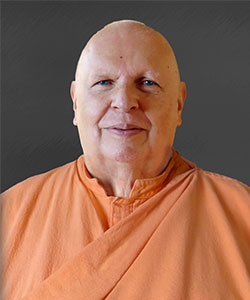
Swami Nirmalananda Giri (Abbot George Burke)
Swami Nirmalananda Giri, founder of Light of the Spirit Monastery, has spent over six decades immersed in the study and practice of Yoga and and the spiritual traditions of East and West. He is the author of more than 30 books on meditation, practical spiritual life and Sanatana Dharma.
Learn more »

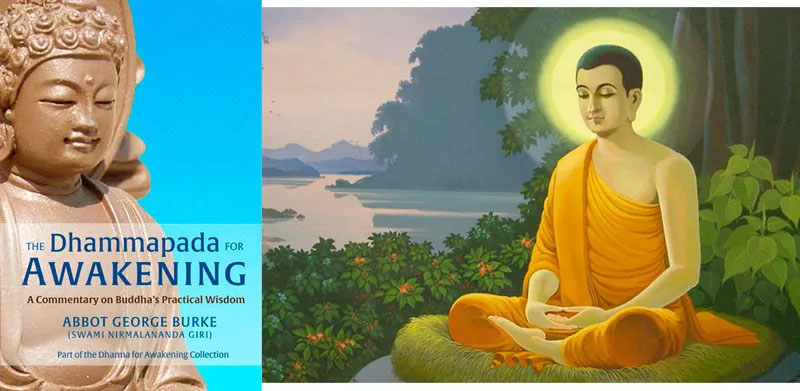
This article is an excerpt from The Dhammapada for Awakening: A Commentary on the Buddha’s Practical Wisdom, by Swami Nirmalananda Giri (Abbot George Burke), available at Amazon.com in print and Kindle formats.
Here are excerpts of some of the Amazon reviews:
★★★★★ Great Authority, Great Topic
“There is no modern scholar who in my opinion has a better grasp of these topics than Abbot George. Highly recommended for the sincere seeker who is not content with labels, but wishes to understand. You will find no better living teacher than this one.”
★★★★★ THE translation you NEED to own!
“…I would go as far as to say this is a must read for anyone trying to further their understanding of not only the teaching of the Buddha but the teachings contained in Christianity and Hinduism as well…. If I was teaching a course on Comparative Religion, Buddhism or any religious studies course I would have this on the must read list.”
★★★★★ Summary of The Dhammapada For Awakening
“…Full of no-nonsense wisdom along with the insights of a lifetime, I get a clear sense, not only of the Father’s personal knowledge, but also of how well he blends it in with the enduring knowledge of the Dhammapada itself. This is a valuable read.”
