
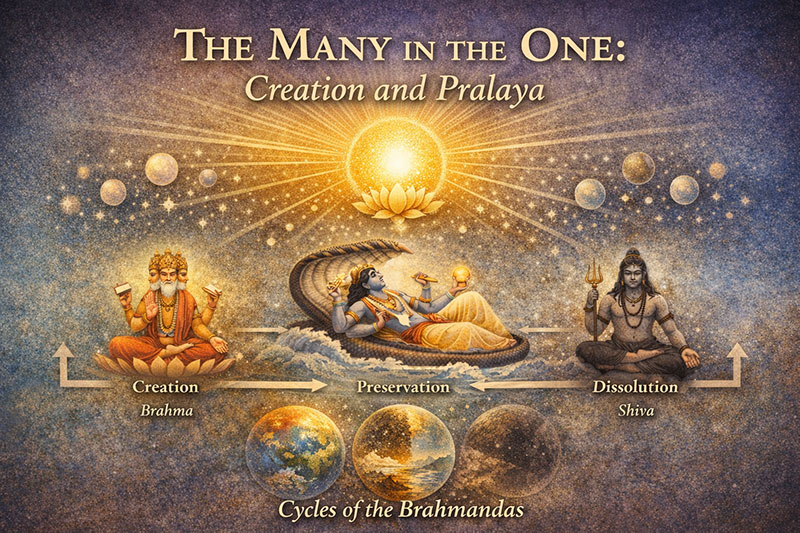
The Many
“At the approach of [Brahma’s] Day, all manifested things come forth from the unmanifest, and then return to that at [Brahma’s] Night. Helpless, the same host of beings being born again and again merge at the approach of the Night and emerge at the dawn of Day. But there exists, higher than the unmanifested, another unmanifested Eternal which does not perish when all beings perish. This unmanifest is declared to be the imperishable (eternal), which is called the Supreme Goal” (Bhagavad Gita 8:18-21).
Here, in a few slokas, the coming forth of The Many is stated. At the beginning of the day of manifestation, all beings stream forth from the unmanifested Root of matter, mulaprakriti, from “This” in darkness, as the Manu Smriti has it. When the day is over, and the night of pralaya comes, then all these separated existences again dissolve into mulaprakriti. Over and over again this occurs, for universes succeed universes, in endless succession. Behind this, then, there must be another Unmanifested, Ishwara, the Saguna Brahman, other than mulaprakriti, the Indestructible Lord. The wise man “perceives the various states of being as resting in the One, and their expansion from that One alone” (Bhagavad Gita 13:30).
How it happens
We have now to study the nature of this procession from, or production of, the Sarga, the creation, the sending forth, or evolving.
The Sanatana Dharma does not recognize an unscientific creation, a making of something out of nothing. The supreme Ishwara evolves all beings out of Himself.
“As the spider sends forth and retracts (its web), as in the earth herbs grow, as from a living man the hairs of the head and body, so from the Indestructible the universe becomes” (Mundaka Upanishad 1.1.7). “As from a blazing fire in a thousand ways similar sparks spring forth, so from the Indestructible, O beloved, various types of beings are born, and also return thither… From That are born breath, mind, and all the senses, ether, air, fire, water, and earth, the support of all.… From that in various ways are born the gods, sadhyas, men, beasts, birds” (Mundaka Upanishad 2.1.1, 3, 7).
In the Manu Smriti more details are given as to the order of evolution, and here again it is said that the immediate Creator, Brahma, created all beings from Himself and from the elements previously produced from Himself, as we shall immediately see. Brahmandani, literally Eggs of Brahma, or as we should say, world-systems, are numberless, we are told:
“All around this Brahmanda there blaze infinite crores of other similar Brahmandas, with their envelopes. Four-faced, five-faced, six-faced, seven-faced, eight-faced, successively, up to the number of a thousand-faced portions of Narayana, in whom the rajoguna is predominant, creators each of one world-system, preside in them. Portions of Narayana, called Vishnu and Maheshwara, in whom the sattwa and tamo gunas predominate, also preside in them, performing the work of preservation and destruction in each. They wander about, these Brahmandas, like shoals of fishes and bubbles in a vast mass of water” (Atharvana Mahanarayana Upanishad). “Grains of sand are perhaps numerable, but of universes (there is) not any (numbering). So there is no numbering of Brahmas, Vishnus, Shivas and the rest. In each of these universes there are Brahma, Vishnu, Shiva, and other (devas)” (Devi Bhagavatam 9.3.7-8).
This we could have imagined, even had we not been told it, for since, as we saw in the Vishnu Purana, the
“one only God, Janardana, takes the designation of Brahma, Vishnu and Shiva accordingly as He creates, preserves, or destroys, and creation, preservation and destruction must go on in every world-system, God must manifest in each in these three Forms.”
This is the Trimurti, the reflection as it were in Space and Time of that Supreme Triple Unity, the Source of beings–the Nirguna Brahman, the Saguna Brahman and mulaprakriti, outside of Space and Time, Eternal. The Trimurti is the manifestation, then, of Ishwara in a world-system, or Brahmanda, and is therefore the supreme will, wisdom and activity in a concrete form.
The Cycle of Manifestation: From the One into the Trimurti
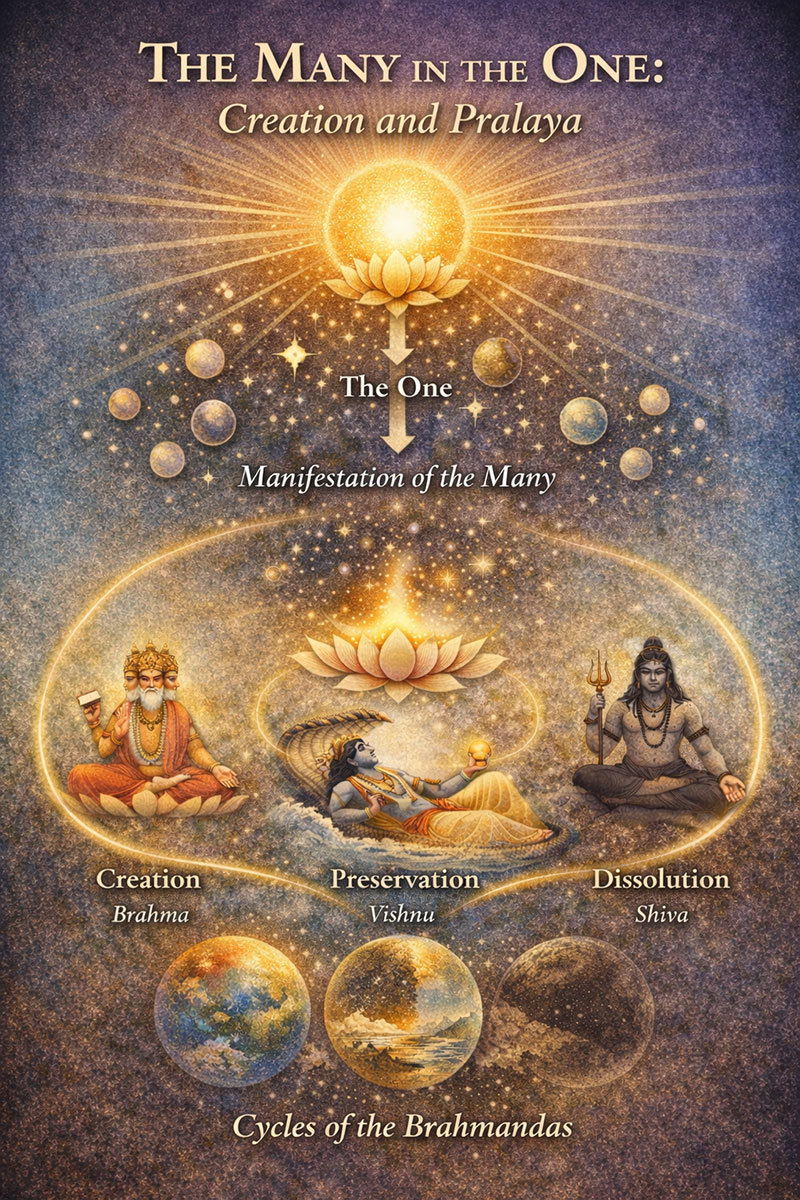
Brahma, Vishnu and Shiva
Brahma is the Creator, and His Shakti is Saraswati, the Goddess of Wisdom, without whom activity could not be wisely guided. He is pictured as with four heads, one looking towards each quarter, as the Maker of the four quarters and their contents, and riding on the Hamsa, the Swan. The name hamsa, a rearrangement of sah, aham, Soham, is an allusion to His relation with ahamkara, the divider, the maker of atoms.
Vishnu is the preserver and sustainer, the principle underlying and sustaining the universe in order, and preserving forms, holding them together by His attracting force. His Shakti is Lakshmi, the Goddess of Happiness, of Prosperity, of all desirable objects. He is pictured with four arms, as sustaining the four quarters, and rides on Garuda, the emblem of speed and of intelligence. He is the source of avataras, and in them, or in His own person, is perhaps the most generally worshipped manifestation of Ishwara. Indeed, as Narayana, He whose dwelling is in the (causal) waters, He is worshipped as Saguna Brahman, dwelling in matter.
Shiva, or Mahadeva, or Maheshwara, is the destroyer (dissolver), He who frees the atman from imprisoning forms, who destroys avidya and so gives vidya, and who, finally rolling up the universe, brings the peace of liberation. His Shakti is Uma–ichchha shakti, will–called also Brahmavidya, who reveals Brahman.
He is pictured always as an ascetic, it being He who is the object of worship for yogis, who have renounced the world. He rides on the bull, the emblem of the mind (and sometimes of physical nature), as having subdued it, and wears the tiger-skin, the emblem of the slain desire-nature. Hence He is, as the name Shiva implies, ananda, the peace and bliss of the atman, freed from desire and master of mind.
These supreme forms of Ishwara, separated by their functions but one in essence, stand as the central life of the Brahmanda, and from and by them it proceeds, is maintained, and is indrawn. Their functions should not be confused, but their unity should never be forgotten.
Previous Articles in the Series:
- Shakti and Maya in Sanatana Dharma: The Power Behind Creation
- The Three Gunas: How Nature Behaves
- Unity in Duality and Duality in Unity: Satchidananda
- Realizing the One Existence: Brahman and the Jivatman
FAQ–”The Many,” Pralaya, and the Trimurti
What does “The Many” mean in Sanatana Dharma?
“The Many” refers to the countless beings, worlds, and forms that emerge from the One Supreme Reality. Though they appear separate and distinct, they arise from and ultimately return to the same divine Source.
What is pralaya?
Pralaya is the cosmic dissolution that occurs at the close of a cycle of manifestation. During pralaya, all forms dissolve back into the unmanifest state, only to emerge again when a new cycle begins.
Does Sanatana Dharma teach creation out of nothing?
No. The universe is not created from nothing. The scriptures teach that Ishwara evolves the universe from Himself, just as a spider spins a web from its own substance.
What is a Brahmanda?
A Brahmanda is a world-system or cosmic “egg.” The scriptures teach that there are innumerable Brahmandas, each with its own cycle of creation, preservation, and dissolution.
What is the Trimurti?
The Trimurti refers to the threefold manifestation of Ishwara as Brahma (Creator), Vishnu (Preserver), and Shiva (Dissolver). Though distinct in function, they are one in essence.
Are Brahma, Vishnu, and Shiva separate gods?
No. They are functional expressions of the one Ishwara within a world-system. Their unity must never be forgotten, even though their roles differ.